Why residents in Almere are fighting legally to uphold their old promises
Almere, vrijdag, 14 november 2025.
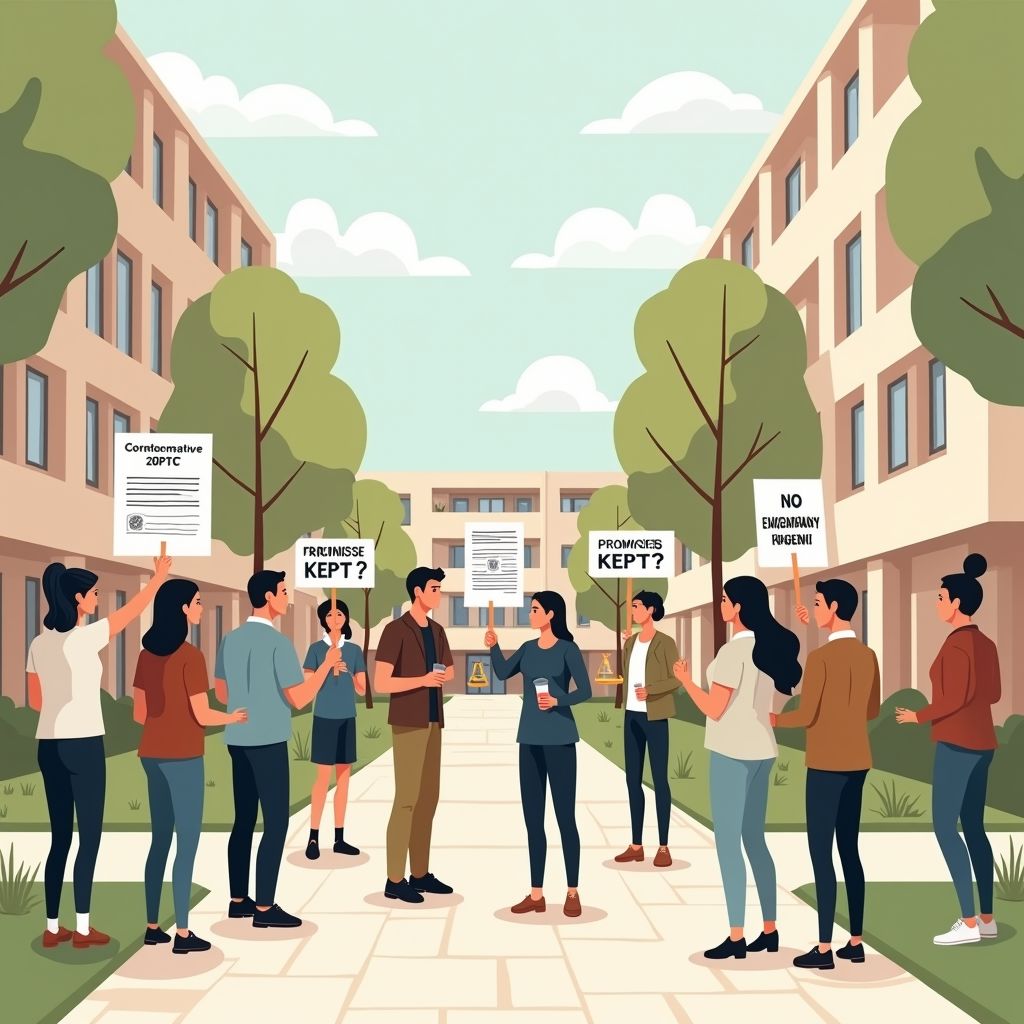
Residents of the Esplanade in Almere are engaged in a prolonged legal battle against the municipality, after their 2018 promise of 300 luxury apartments was replaced with a Windesheim university campus. The most astonishing development? In 2021, the plan was completely reversed without transparency, while the municipality claims the modification of the building permit was legally valid. Residents feel misled and are pressing ahead with their case until the ruling on 27 December, despite a chain of information denials and suspicions of manipulation. This struggle highlights how crucial transparent communication is in spatial planning—especially when trust between citizens and government has been broken.
The origin of the conflict: promises from 2018 and an unexpected reversal in 2021
The legal dispute between Esplanade residents and the municipality of Almere stems from a 2018 commitment, when the municipality pledged that 300 luxury apartments would be built on the Esplanade’s parking lot [1]. According to Co Pieters of the residents’ collective, this plan was a ‘fantastic idea embraced by everyone’ [1]. The expectation was that the project would strengthen housing demand in central Almere and improve the livability of the neighbourhood. However, in 2021, this expectation was abruptly shattered: the municipality introduced an entirely new plan—a university campus with student housing—without prior transparent communication or resident consultation [1]. This sudden shift, lacking explanation or spatial debate, left residents bewildered and uncertain. The sense of a broken trust relationship has since become the core of their protest [1].
Legal basis of the adjustment: legal validity versus breach of trust
On Thursday, the administrative court in Lelystad held a hearing on the legal validity of the amendment to the building permit for the Windesheim university campus [1]. Residents dispute whether the adjustment was legally permissible, arguing that the new plans fall outside the zoning plan and received no public disclosure or debate [1]. The municipality contends, however, that the amendment was lawful, despite refusing to provide information under the Wet open overheid (Woo) [1]. Residents have submitted dozens of Woo requests, yet they receive no reports from objection committees, leaving them in the dark about the amendment process [1]. This lack of transparency strengthens their perception of manipulation and being misled [1]. The ruling on the permit amendment is scheduled for 27 December 2025 [1].
Loss of transparency: residents confused, municipality cornered
Since 2021, residents have been on the defensive. They describe the municipality’s stance as uncommunicative and dismissive of responsibility [1]. John Kraak, a resident, reports having a ‘bad feeling’ about how the municipality treats citizens and claims there has been ‘lying and deceit’ [1]. His group is said to be part of a mediation process, yet they have no details about it [1]. This absence of communication and accountability pressures residents and strengthens their determination to push through to the ‘endgame’ [1]. According to the residents, the municipality ‘is digging itself deeper into a corner’ [1]. Rather than offering solutions, the process seems subordinate to preserving its own policy. Residents wish to return to the original 2018 plan—300 luxury apartments—not a student housing campus [1].
A contrasting approach in Kruidenwijk: residents as construction partners
While trust has been broken in the Esplanade, Kruidenwijk in Almere demonstrates a completely different path. In 2025, a pilot project called ‘Bouwen door de Buurt’ (Building by the Neighbourhood) was launched, in which residents themselves organize the participatory process for building seven homes on a green strip [2]. This approach, supported by municipal supervision, is based on a ‘yes, provided that’ principle rather than ‘no, unless’ [2]. The municipality of Almere developed this initiative together with residents and legal advisors, ensuring an objective, verifiable, and reasonable selection process for participants—meeting the standards set by the Didam ruling, according to legal assessment [2]. The result was a strong majority in the municipal council, full public support, no appeals announced, and an expected construction start in 2026 [2]. This contrast illustrates how an open, participatory, and transparent process can restore residents’ trust and deliver new homes without legal conflict [2].
Municipal and governmental perspectives: a new approach to spatial planning
The national government emphasizes that adjusting building regulations with a focus on participation and balanced function distribution across locations (EFTAL) is essential for the future of spatial planning [2]. Government commissioner Kars de Graaf stresses that the shift from ‘no, unless’ to ‘yes, provided that’ since 1 January 2024 forms the foundation of the new Omgevingswet [2]. This creates more space for bottom-up initiatives like ‘Bouwen door de Buurt’ [2]. Hans Broere from the Ministry of Infrastructure and Water Management explains that such initiatives help residents with limited chances on the housing market take a step forward, while also strengthening connections between people and places [2]. From this perspective, the approach in the Esplanade—lacking transparency and participation—appears to deviate from overarching policy [2].
Looking ahead: construction start in 2026 and the risk of lost trust
The construction of the seven homes in Kruidenwijk is scheduled for 2026, following the political decision on the zoning amendment in the municipal council in 2025 [2]. The planning preparation advanced quickly: residents designed their own homes, and a plot deed was drawn up as construction regulation [2]. This process, completed in less than four years, demonstrates how residents can act as active partners in spatial development [2]. In contrast, the conflict in the Esplanade remains unresolved, with a ruling scheduled for 27 December [1]. If the court does not approve the permit amendment, the municipality would be forced to revert to the 2018 plan—or renegotiate with residents [1]. The likelihood of such a ruling remains unclear, but the damage to trust is already evident [1].