How an AI robot chooses your next book – without knowing your name
amsterdam, woensdag, 5 november 2025.
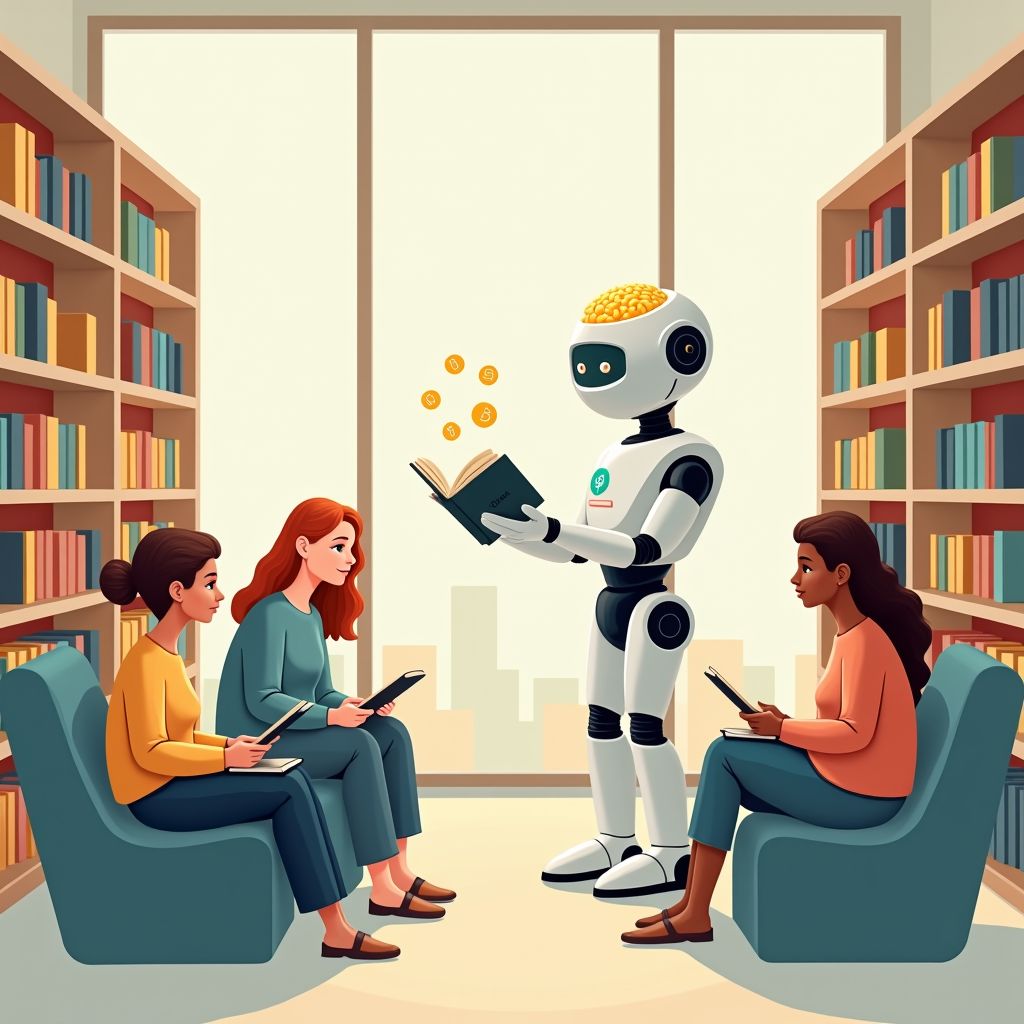
Imagine a book that perfectly matches what you enjoy, before you even realise it yourself. Dutch libraries are now introducing an AI system that generates book recommendations based on reading behaviour – without storing any personal data. The most striking aspect? It uses machine learning without revealing your identity. This balance between personalised recommendations and privacy is currently being tested across 12 regions, with a nationwide rollout planned for early 2026. It’s not about surveillance, but about trust – and that’s exactly what the new digital library is all about.
AI that reads without knowing your name
Since Wednesday, 5 November 2025, the Provincial Library of North Holland has been operating a new system that generates book recommendations based on reading behaviour – without ever revealing your identity. The system, which entered a testing phase on 2025-11-01, uses machine learning to analyse patterns in reading behaviour, such as the genres you frequently choose, how long you read a book, or whether you return to certain authors [1]. These data are processed through a data anonymisation procedure that became effective on 2025-11-03, ensuring no personal information can be directly linked to a user [1]. ‘Reader privacy is paramount: we do not use data that can be directly linked to an individual’ [1], explains Anneke van der Velden, CTO of the Provincial Library of North Holland. The system is currently integrated into 12 provincial and municipal libraries, with the goal of reaching the entire country by 2026-01-01 [1].
From general search function to personalised guidance
In the past, libraries primarily acted as librarians: you searched by title or author, and received the books you requested. Now, AI replaces endless manual searching. Instead of manually browsing, users can now receive a book that feels as if it were chosen by their own hand, without typing anything. The system learns from the behaviour of hundreds of users with similar tastes, and generates recommendations based on behaviour—not identity [1]. At Utrecht University Library, research into using AI to support academic search queries has been ongoing for some time, with tools developed to help researchers find relevant sources more quickly [4]. This demonstrates that the shift from traditional catalogues to AI-driven recommendations is not an exception, but a significant acceleration in digital research. Therefore, integrating AI into search systems is no longer a luxury, but a necessary step to meet the growing demand for fast and relevant information.
The digital assistant that picks your book – without recognising you
Beyond recommendations, AI also helps automate processes that were once time-consuming. For instance, cataloguing new books and digital resources is now faster, more accurate, and more consistent. The National Archives and the Royal Library (KB) are collaborating on digitising historical collections, where AI is already being used to restructure old catalogues and identify unclear titles [3]. The KB’s website clearly states that technological progress enables faster dissemination of ideas, with AI playing a key role in processing vast amounts of information [3]. Promptotheek.nl, a free platform for Dutch AI prompts, also offers tools to optimise AI workflows in organisations, including libraries [5]. Although these tools are not specifically designed for libraries, they illustrate how AI can be systematically applied to simplify complex tasks—from writing descriptions to managing digital archives. This automation shifts the role of librarians from ‘archive keepers’ to ‘digital guides’.
The power struggle over data in the digital age
The deployment of AI in libraries takes place within a broader debate about data power. In November 2025, discussions are underway about a ‘power struggle’ over who controls what we read, how we read it, and who has access to our reading behaviour [1]. This struggle is not only between government and citizens, but also between technology companies and society [1]. The Dutch Second Chamber approved the Temporary Cyber Act on 2025-11-02, which establishes a binding regulatory framework for CTIVD and the right to appeal for services [1]. This shows that the government is aware of the potentially dangerous implications of data processing—even in sectors like libraries. Bits of Freedom expressed concerns on 2025-11-03 about the possible expansion of government oversight and privacy restrictions, intensifying the debate around AI in public services [1]. As such, the application of AI in libraries is not only a technological issue, but also an ethical and political one.
Transparency and citizen participation as the foundation of trust
Without transparency, even the best AI system can fail. That is why Dutch libraries place strong emphasis on ‘engaged critique’ and citizen participation in AI development [1]. The Dutch Library Council has planned an evaluation for 2025-11-20, which will examine how the system functions, whether it is effective, and whether it meets privacy requirements [1]. This evaluation stems from the concept of ‘Civic Intelligence Oversight’, where transparency and societal engagement are central [1]. Experts in the field, such as Goede, Van Puyvelde, Bakir, Kniep, and Roller, stress that ‘engagement all the way down’ is essential—not just technically, but also socially and ethically [1]. Therefore, the balance between personalised recommendations and privacy is not resolved solely through technology, but also through democratic decision-making—via open discussion, oversight, and public input.
The future of the library: more than just a book tent
The future of the library is not only based on technology, but on the connection between people and knowledge. Integrating AI into service delivery should lead to greater accessibility—not only for highly educated individuals, but for everyone, including people with visual or cognitive impairments. In the Bibliotheek Waterland, a nationwide campaign is being organised where the entire country reads ‘Onder de paramariboom’ by Johan Fretz, to create shared reading experiences [2]. This shows that the library is not only a technological space, but also a cultural one. AI can help here by generating recommendations that are not only personal, but also culturally relevant—such as enriching offerings with books from diverse backgrounds. As a result, the role of the library staff shifts from ‘bookkeeper’ to ‘knowledge coordinator’, working alongside AI to guide people toward their next great read.