A Step into the Past: How a Dutch Street Comes to Life in 2026
Nederland, dinsdag, 18 november 2025.
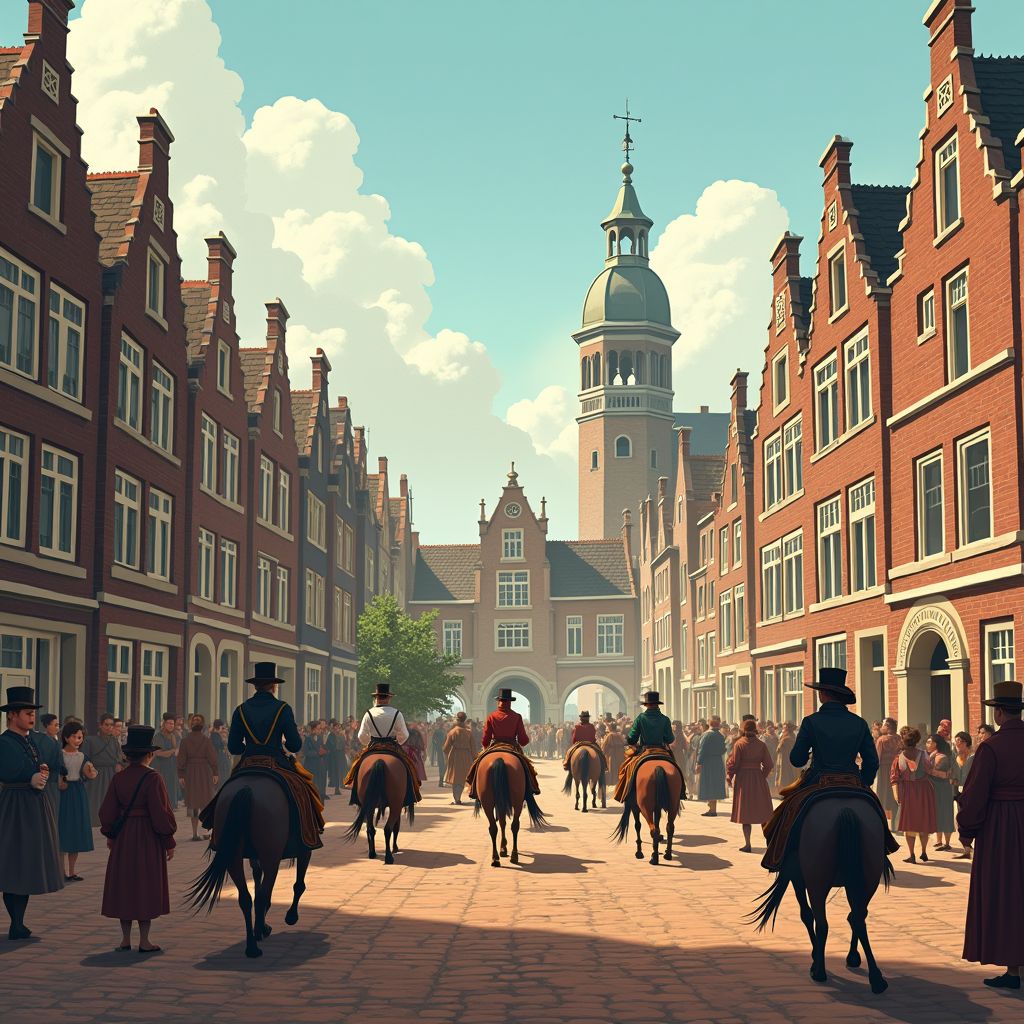
Imagine standing on the Rokin in Amsterdam, and suddenly the 17th century unfolds before your eyes: a vivid depiction of the world’s first stock exchange, with people in period clothing and horses trotting over the cobbles. That is exactly what the new series ‘Straten van Toen’ achieves, using artificial intelligence to seamlessly reconstruct historical scenes from old paintings, photographs, and archival material. Launching on HISTORY from January 2026, the series allows viewers to experience how the Netherlands once looked in real time—without disrupting the narrative. The most striking element is that historian Corjan Mol himself appears within these past scenes, as if he has truly travelled back in time. A unique fusion of technology and history that does not just make the past readable, but truly tangible.
From Viewers to History: The Power of AI in the Prelude to the Past
With the launch of the series ‘Straten van Toen’ on 16 November 2025, producer Hearst Networks, in collaboration with the AI-driven company Particle6, is revolutionising the way Dutch history is presented. This 10-episode project for The HISTORY Channel in the Netherlands leverages artificial intelligence to seamlessly integrate historical scenes with live-action footage of the present day. By drawing on archival materials, paintings, engravings, and old photographs, AI generates realistic reconstructions of cities and streets from the past, such as the Rokin in Amsterdam, which in the 17th century was the hub of the world’s first stock exchange [1][2][3][4][5][6]. The technology delivers viewers a visually dramatic image of how the Netherlands once looked, enhancing the viewing experience through immersive, AI-generated environments meticulously crafted for historical authenticity [6][7].
Corjan Mol: The Human Bridge Between Present and Past
The central figure of the series is historian Corjan Mol, known for his role in ‘The Curse of Oak Island’. In each episode, Mol begins at the site of a historical street or location in the present day and embarks on a journey to uncover the past. With the help of AI, he is digitally placed within a reconstruction of the corresponding era, where he appears in cameo roles in historical events [2][3][5][6]. This technique enables viewers to experience both the present-day setting and the historical past simultaneously, making the narrative not only visually compelling but also emotionally resonant [1][7]. The blend of real historical figures and fictional characters within each scene serves as a tool to convey complex history through stories grounded in factual events [2][3][4][5].
The Technical Framework: How AI Revives History
The technical foundation of ‘Straten van Toen’ lies in the AI technology developed by Particle6, a company founded by Eline van der Velden. Although the company has previously used AI for behind-the-scenes tasks such as research and post-production, this is the first series where AI is deployed on a large scale on screen [1][2][3][5][6][7]. The AI generates scenes based on archival materials, ensuring a high degree of accuracy in the reconstructions [1][2][3][4][5][6]. The software integrates movement, lighting, shadows, and intricate details such as clothing and vehicles to deliver a realistic and cinematic experience [1][2][3][5][6]. This is made possible through a combination of deep learning models and generative AI inspired by historical visuals, enabling the AI not only to fill in missing images but also to interpret the context of the time [1][3][4][5][6].
Broader Impact: AI in Public Education and Communication
The success of ‘Straten van Toen’ demonstrates that AI can be a powerful tool in public education and communication. As Sam Pearson, Head of Short Form Commissioning at Hearst Networks, emphasizes, AI unlocks creative possibilities once thought impossible, allowing audiences to experience history in a way that is both visually striking and educational [1][6][7]. This application of AI in historical storytelling can serve as a model for other sectors, such as health education, climate communication, and civic engagement. In the context of personalised information delivery, AI technology can leverage user data to tailor content—such as placing a user in a specific historical period or region and displaying relevant history [GPT]. Awareness campaigns can use AI to measure the impact of their messages through interaction patterns, viewing duration, and social sharing, thereby making campaign effectiveness demonstrable [GPT].
Challenges and Ethical Considerations
Despite its benefits, the use of AI technology raises ethical concerns. The creation of the AI actress Tilly Norwood, which sparked international debate in 2025, has drawn attention from actors’ unions such as SAG-AFTRA regarding the potential replacement of human performers by synthetic characters [4][7]. Producer Eline van der Velden, however, stresses that AI in ‘Straten van Toen’ is a creative partner, not a replacement, and that all AI usage is coordinated by humans [1][2][3][5][6][7]. Still, questions remain about the clarity of the boundary between reviving the past and creative interpretation—particularly when fictional characters are used to tell stories [2][3][5][6]. There is also a pressing need for transparency: viewers must be informed that images are AI-generated, not direct historical documents [7].