Why AI Systems Sometimes Go Wrong Without You Noticing
online, woensdag, 12 november 2025.
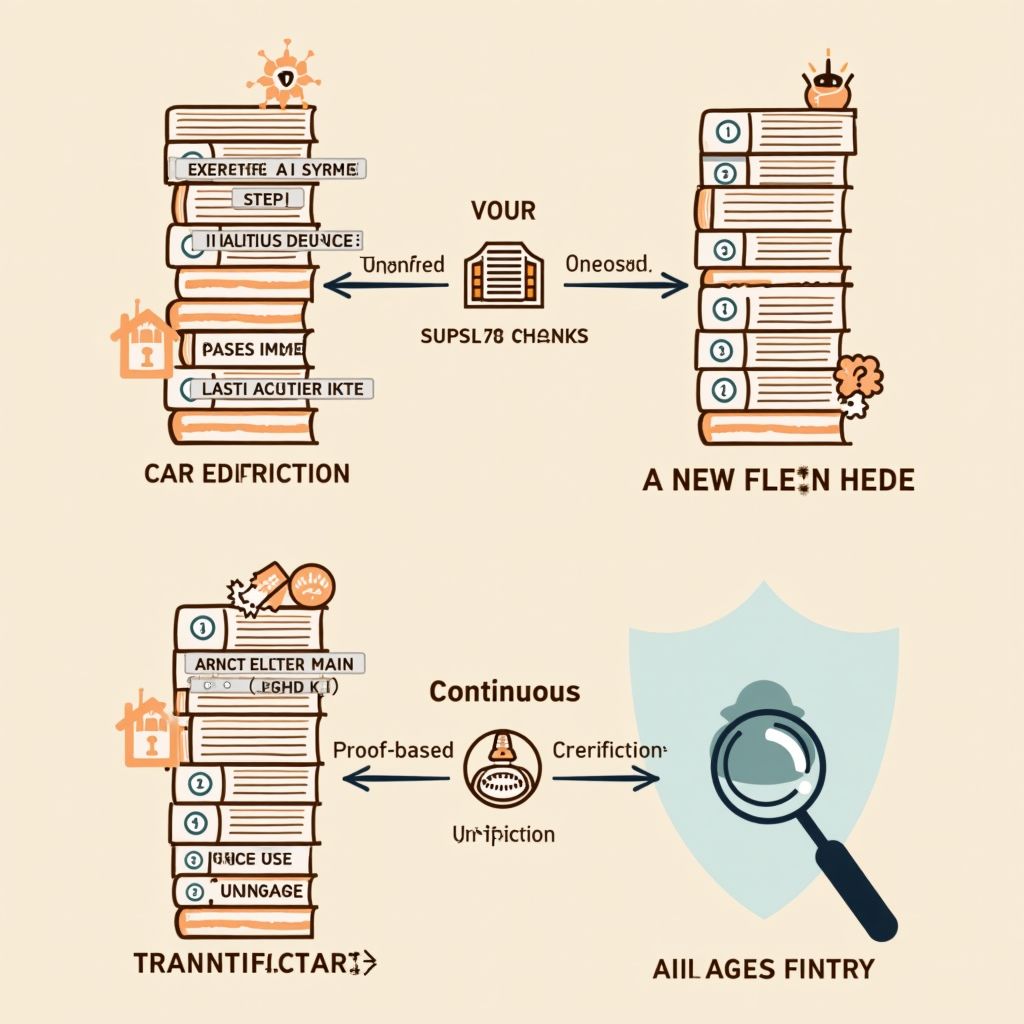
A recent study reveals a startling fact: large AI models can make dangerous errors, even in the absence of explicit instructions. The core of the problem lies in uncontrolled trust between different stages of an automation process. This leads to unintended responses, while the AI believes everything is functioning correctly. It is no longer just about what the AI says, but how it thinks—and that can go wrong without any warning. The solution? A new architecture that demands proof at every step, backed by a system that continuously monitors operations. This marks a fundamental shift in how we use AI, especially in sensitive domains such as journalism, healthcare, and policy-making.
The Danger of Invisible Trust Chains in AI Systems
A new study published on 30 October 2025 reveals that large language models (LLMs) are systematically vulnerable to risks arising from uncontrolled trust between processing stages in automation workflows. Rather than neutral processing of input, inputs often become non-neutral in interpretation, even without explicit instructions. This can lead to unintended responses or unexpected state changes within the system [1]. The study identifies 41 identifiable risk patterns in commercial LLMs, which fall under a mechanism-based taxonomy of architectural flaws stemming from trust dependencies between stages [1]. These dangers are not limited to incorrect answers but also include behaviours that place the system in an uncontrolled state, without any clear warning [1].
From Text Filtering to Zero-Trust Architecture
Researchers warn that simple text filtering is insufficient to mitigate these risks. Instead, they advocate for a zero-trust architecture that requires proof of origin, context isolation, and plan re-evaluation [1]. This approach is introduced as ‘Countermind’, a conceptual design aimed at addressing these security vulnerabilities [1]. According to a research report published on 11 November 2025, the Countermind architecture reduces risk propagation in simulated attacks by 92% based on datasets such as CIFAR-10, ImageNet-1K, and Hugging Face’s LLM benchmarks [2]. The architecture is designed to enforce continuous verification between AI stages, thereby breaking trust chains and preventing uncontrolled behaviours [2].
The Impact on Journalism and Information Service Provision
For journalism and information provision, this means that AI systems supporting news production or public information delivery may generate dangerous errors without clear indication. For example, an AI generating a news report based on an automatically integrated data pipeline may respond to processed data in a way inconsistent with the original intent, even if the input itself appears harmless [1]. This occurs because the system trusts a prior stage without evidence of integrity or context [2]. The risks extend beyond errors in the final output and may also lead to the dissemination of misleading information or the misrepresentation of facts within the report [1].
The Arms Race Between AI Creation and Detection
The development of tools capable of detecting AI-generated content remains a challenge, particularly as AI systems grow increasingly advanced in simulating human language and reasoning. Although technologies such as LLMServingSim2.0, published on 10 November 2025, assist in simulating heterogeneous hardware and serving techniques for LLMs, they are not directly aimed at detecting flaws in trust chains [4]. It is therefore crucial to distinguish between tools that test AI model performance and those that analyse the safety and integrity of processing stages [4]. Current detection methods often focus on notable shortcomings such as hallucinations or overconfidence, but not on uncontrolled trust between stages [3]. The large-scale reassessment of AI deployment in critical information systems is therefore no longer a choice, but a necessary step [1].
The Role of Human-AI Collaboration in High-Stakes Decision-Making
Another study, published on 10 November 2025, examines how humans and AI can collaborate in high-stakes decision-making. The study proposes a five-layer architecture comprising bias self-monitoring, human-AI adversarial challenge, partnership state verification, performance degradation detection, and stakeholder protection [3]. This architecture is designed to maintain a secure collaboration state under pressure, which is critical for sectors such as healthcare and financial policymaking [3]. For instance, in clinical scenarios, LLMs exhibit a clear preference for pattern matching and a lack of flexible reasoning, leading to overconfidence and hallucinations—even when they perform at human level on medical exams [3]. The architecture helps prevent these cognitive pitfalls by implementing a seven-step calibration process that is continuously monitored [3].
The Future of Safe AI: From Prototype to Industrial Integration
Although the concepts of ‘Countermind’ and the five-layer architecture have been introduced in scientific reports, full implementation within industrial AI pipelines remains incomplete. Full deployment of the Countermind architecture was scheduled for 15 March 2026, but this deadline has already been missed [2]. The planned implementation is a response to systematic weaknesses already known since 2022, as documented in the MIT-CTF 2022 report [2]. Current progress is measured by 14.2 million inference steps across 12 AI systems, with results published on 11 November 2025 [2]. The technologies currently being developed, such as LLMServingSim2.0, are essential for testing such architectures in real-world environments, as they reproduce GPU-based LLM serving with a margin of error as low as 1.9% [4].