How a President Pressured the Media: The Secret of the 'Grey Room' in Washington
Washington D.C., dinsdag, 9 december 2025.
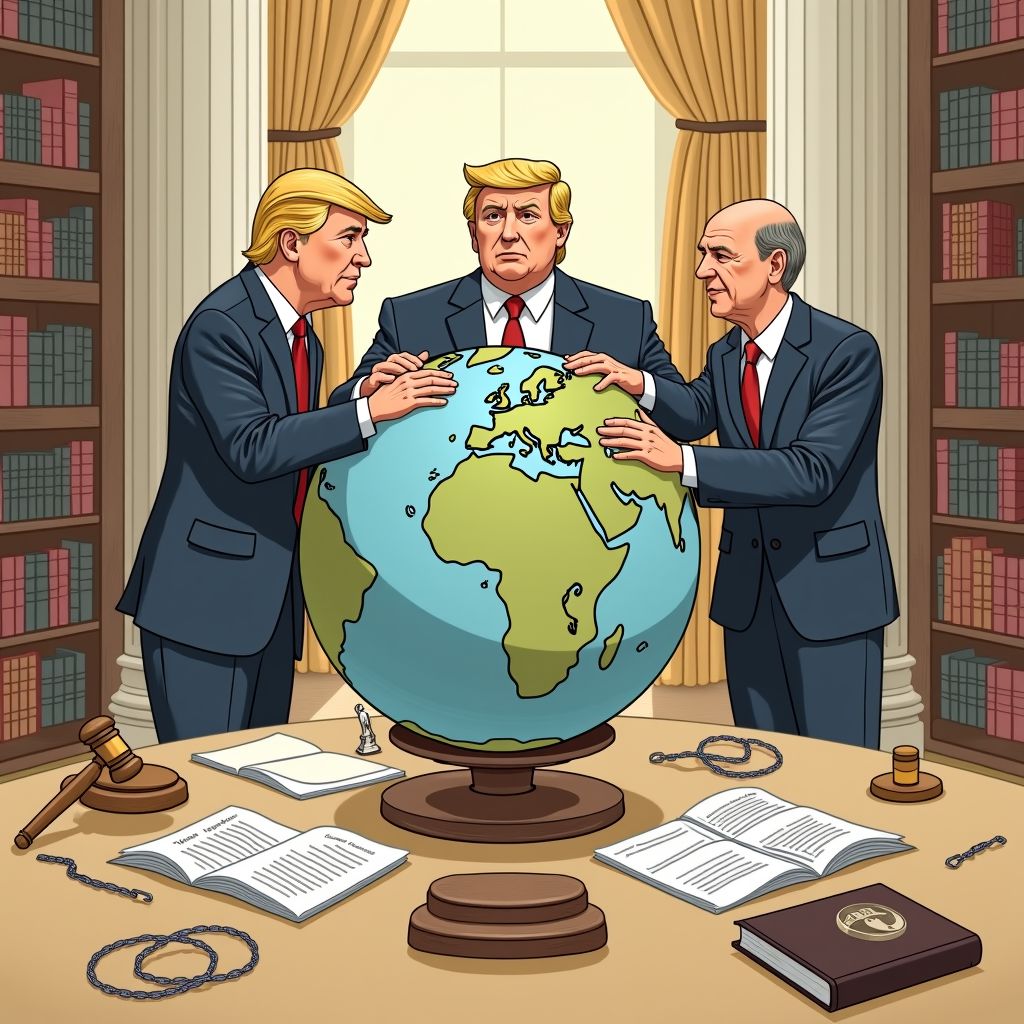
During Donald Trump’s second term, the American media landscape shifted faster than ever before. While journalists continue to carry out critical reporting, major media owners—such as the new head of CBS and the newly appointed leadership of The Washington Post—have been pressured through legal actions, economic sanctions, and political threats. Most alarming is that one of the largest media oligarchs, Larry Ellison, collaborated closely with the White House to gain control over CNN—and was even praised by Trump as ‘the biggest step forward for a free and open press.’ These strategies, reminiscent of Viktor Orban’s approach in Hungary, reveal how political power can finally assert control over the media not through direct censorship, but via financial and legal pressure. The result: a press that censors itself, while truth vanishes into the shadows.
The Technology Behind Vigilance: How Alphabet AI Detects Deepfakes
On Tuesday, 9 December 2025, Alphabet launched a real-time AI tool for detecting deepfakes on YouTube, a move that significantly impacts the digital security of millions of users in the West at a critical moment. Developed by Google DeepMind, the tool uses advanced machine learning models trained on over 10 million video samples to detect subtle inconsistencies in facial expressions, audio-visual synchronization, and lighting anomalies [1]. During an internal testing phase between 15 November 2025 and 5 December 2025, the system achieved a precision rate of 98.7% in identifying manipulated videos among 127,000 test videos [1]. The tool is now active for all content uploaded in the United States, the European Union, and Japan, with plans to expand to India and Brazil in March 2026 [1]. Prabhakar Raghavan, CTO of Alphabet, emphasized that the tool’s purpose is to protect users from disinformation campaigns that could undermine democratic processes [1]. Dr. Elena Vasquez, AI ethics advisor at Google DeepMind, described it as a ‘defensive measure against the weaponization of AI in political discourse’ [1]. Although the tool has been operational since 6 December 2025 [1], its expansion to India and Brazil remains unconfirmed, which [alert! ‘the exact activation date in those countries has not been verified’]. The technology responds to growing concerns about AI-driven manipulation in political campaigns, as observed during the lead-up to the 2024 U.S. presidential elections and the subsequent phase of Trump’s second term [1].
From Criticism to Conformity: The Suppression of Media Oligarchs in Trump’s Second Term
During Donald Trump’s second term, the image of the American media shifted from an independent watchdog to an instrument of political dependency. According to Media Matters, pressure on media oligarchs has significantly intensified through a combination of state power, legal actions, and economic sanctions [2]. The strategies closely mirror those of Viktor Orban in Hungary, where the state has undermined press independence through regulation and economic pressure [2]. A clear example is the acquisition of CBS News by Skydance Media, following approval from the Federal Communications Commission on 1 July 2025, after which David Ellison, son of Larry Ellison, assumed leadership [2]. In the months that followed, major reorganizations took place, including the dismissal of nearly 100 CBS News staff members, particularly within departments focused on climate, race, and culture [2]. On 2 November 2025, Trump praised the takeover as ‘the biggest thing that’s happened in a long time for a free, open, and good press,’ providing direct endorsement of a politically integrated media structure [2]. Similarly, in 2025, Jeff Bezos, owner of The Washington Post, faced internal pressure to restructure the opinion pages. On 26 February 2025, Bezos instructed the opinion section to consistently advocate for ‘personal freedoms and free markets,’ leading to the departure of opinion editor David Shipley [2]. In June 2025, Adam O’Neal was appointed as the new opinion editor, who subsequently oversaw the dismissal of seasoned journalists such as Alyssa Rosenberg and the hiring of conservative writers [2]. These changes led to a sharp decline in subscribers: according to David Folkenflik of NPR, the net subscriber loss at The Washington Post by the end of February 2025 had reached ‘a few hundred thousand’ [2]. These shifts in the American media structure demonstrate how economic dependency and political coercion can work in tandem to erode journalistic integrity.
The Danger of Political Influence via Media Owners: The Case of Warner Bros. Discovery
Trump’s strategies for pressuring media oligarchs extend beyond CBS and The Washington Post. The future of Warner Bros. Discovery (WBD) became a central pillar in the political struggle for control over American media. On 31 October 2025, the New York Post reported that Trump aimed to place WBD under the control of the Ellisons, as he sought ‘favorable news’ from his own CNN-aligned perspective [2]. Trump’s preference for the Skydance acquisition stems from the belief that the Ellisons—particularly Larry Ellison, a well-known Trump ally—would steer media coverage in a more favorable direction [2]. The White House reportedly discussed replacing CNN presenters such as Erin Burnett and Brianna Keilar should the acquisition proceed [2]. Furthermore, the administration threatened ‘harsh oversight’ of other bidders making offers for WBD, sending a clear signal of economic and legal coercion [2]. Although the plans to acquire WBD are not yet complete, the indications suggest that the president is systematically reshaping the media structure to align with his preferences [2]. This approach—where state and private sectors collaborate to create a media ecosystem compliant with political ideology—points to a new form of media transformation, driven not by direct censorship but by financial and legal pressure [2].
The Line Between Technology and Manipulation: Ethical Challenges of AI in Journalism
While Alphabet provides a powerful tool to detect deepfakes, the ethical implications of technology in journalism remain complex. The real-time AI tool for YouTube is designed to prevent misinformation, but there remains a risk that such systems could be repurposed as censorship mechanisms, especially when deployment is influenced by governmental or commercial interests [1]. Dr. Marcus Bell of the Stanford Internet Observatory emphasized that the system represents a ‘critical step forward’ in combating AI-driven disinformation, yet warned that ‘it cannot be ruled out that the system could be used to suppress political criticism’ [1]. The use of AI in media is not limited to detection: for instance, in 2024, Patrick Soon-Shiong, owner of the Los Angeles Times, announced a ‘bias meter’ for opinion pieces, which was withdrawn in 2025 after it reportedly downplayed the Ku Klux Klan [2]. In 2025, Soon-Shiong also launched ‘LA Times Studios,’ where influencers read AI-generated scripts, casting doubt on the value of human journalism [2]. Moreover, growing concerns exist that AI-generated content is less transparent than human-written articles, potentially undermining reader trust [1]. The fusion of technology, economic power, and political pressure creates a new ecological system in which truth is no longer determined solely by facts, but also by algorithms, owners, and political preferences [1][2].