Felix Meritis Discusses the Future of AI in Journalism
amsterdam, vrijdag, 17 oktober 2025.
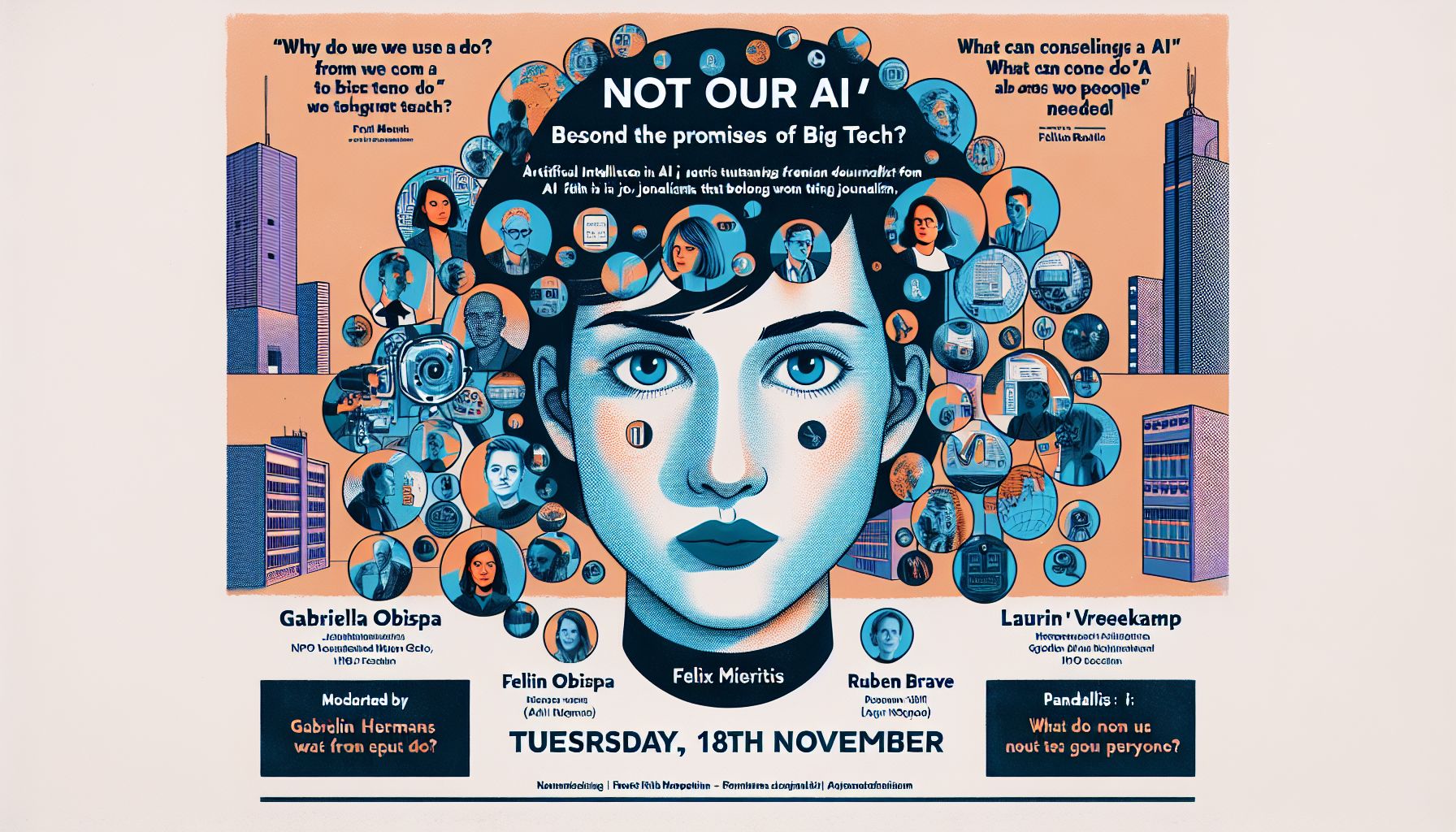
On Tuesday, 18 November, Felix Meritis will host an evening dedicated to the role of AI in journalism, moderated by Karlijn Goossen from NPO. The event will explore how AI can serve as a tool for journalists. The impetus for this discussion is the new book ‘Not Our AI - Beyond the Promises of Big Tech’, in which Gabriella Obispa and Laurens Vreekamp focus on an AI that belongs to us all. Panellists, including Felienne Hermans and Ruben Brave, will discuss how to shift the conversation from ‘how do we use AI?’ to ‘why are we considering AI?’ and from ‘what can the technology do?’ to ‘what do people need?’
The Impact of AI in Journalism
Artificial Intelligence (AI) is increasingly gaining ground in journalism. This technology provides journalists with powerful tools to analyse large datasets, identify patterns, and even generate articles. The event at Felix Meritis on Tuesday, 18 November, will highlight these developments and question how AI can be used as a support tool for journalists, rather than just a technology of tech companies [1].
Technology and Applications
In journalism, AI is primarily used to automate routine tasks, such as generating briefs and summaries of news articles. Natural Language Processing (NLP) enables the rapid analysis of large volumes of text and the extraction of relevant information. This helps journalists, for example, in identifying trends on social media or detecting fake news [2].
Benefits of AI in Journalism
One of the main benefits of AI in journalism is efficiency. Journalists can focus on more complex and creative aspects of their work while AI handles routine tasks. This can lead to faster news reporting and broader coverage. Additionally, AI aids in detecting biases in reporting and enhancing transparency in the news process [1][2].
Potential Drawbacks and Ethical Considerations
Despite the benefits, there are also significant drawbacks and ethical considerations associated with the use of AI in journalism. One of the biggest concerns is the potential for bias in algorithms. If AI systems are trained on biased datasets, they can inadvertently spread biased information. Moreover, reliance on AI can lead to reduced human input, potentially compromising the quality and authenticity of news [2].
Impact on News Production and Consumption
The integration of AI into journalism has a direct impact on both the production and consumption of news. At the production level, journalists can work faster and more efficiently, allowing them more time to conduct in-depth investigations. For consumers, this means more and diverse news is available, but it is crucial that sources remain reliable and transparent. The event at Felix Meritis will discuss these aspects and provide insights into how we can balance technology and human expertise [1][2].
Panellists and Moderator
The evening at Felix Meritis will be moderated by Karlijn Goossen, genre coordinator for journalism at NPO. She will lead a discussion with panellists such as Felienne Hermans, professor of Computer Science Education at Vrije Universiteit Amsterdam, and Ruben Brave, tech entrepreneur and investor. Together, they will provide insights into the possibilities and challenges of AI in journalism and how we can shape a future that belongs to us all [1].
Purpose and Inspiration of the Event
The event is inspired by the new book ‘Not Our AI - Beyond the Promises of Big Tech’, written by Gabriella Obispa and Laurens Vreekamp. The aim is to shift the conversation from ‘how do we use AI?’ to ‘why are we considering AI?’ and from ‘what can the technology do?’ to ‘what do people need?’. The panellists will contribute their expertise to stimulate a broader and more inclusive discussion about AI in journalism [1][2].