How AI spread false stories about a US warship and migration pressure — and now helps debunk them
Brussel, donderdag, 13 november 2025.
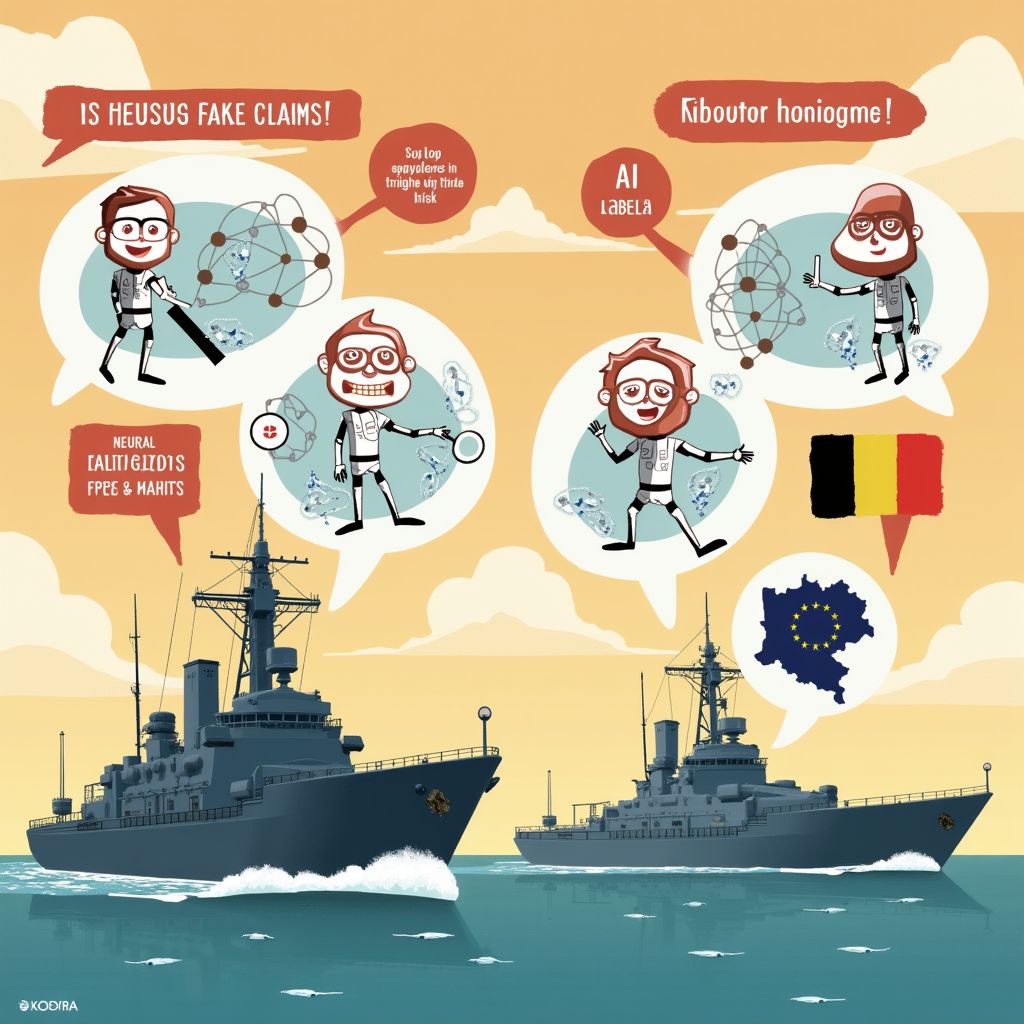
A recent wave of misleading posts around the presence of a US warship in the Caribbean and the European Commission’s notice that Belgium is among countries with “risk of migratory pressure” illustrates AI’s double role: the ship was indeed present, but narratives about military escalation and an alleged immigration surge were amplified by AI‑generated content and bots. Media outlets and researchers are meanwhile using AI tools to recognise fabricated versions and separate fact from fiction, especially in periods of high information pressure. Most intriguingly: the same techniques that spread misinformation rapidly are also the best tools to detect it. Expect in the full article examples of distorted claims, explanations of detection algorithms used, and what the EC classification for Belgium concretely means — discussed in the light of recent events last Tuesday and the rise of mandatory AI labelling in Europe.
The facts in brief
A US aircraft carrier strike group — including the aircraft carrier USS Gerald R. Ford — arrived in the Caribbean last Tuesday, a movement that news reports linked to operations against suspected drug boats in the region [3][1]. At the same time the European Commission reported that Belgium belongs to a group of Member States with “risk of migratory pressure”, based on a report covering the period July 2024–June 2025 [4][5].
How AI helped spread misleading narratives
Social media posts that jumped from the presence of the warship to stories about immediate military escalation, planned waves of immigration or direct migration flows to Belgium circulated quickly thanks to AI‑generated text, synthetic images and distribution channels run by bots — a pattern that newsrooms and fact‑checkers noticed again during recent incidents around military actions and migration claims [1][2][3]. This dynamic matches analyses showing how automated content generation and fake accounts can amplify information exponentially, causing segmented audience groups to rapidly form a distorted picture [2][3].
Concrete examples from the recent wave
In the aftermath of the arrival of the USS Gerald R. Ford, posts circulated images and claims that drew a direct link between the ship’s movement and a sudden migratory pressure on Belgium; some posts cited the European Commission classification but exaggerated it into claims about an imminent ‘immigration shortage’ — distortions that journalists and researchers identified as misrepresentation [1][4][5][alert! ‘uncertainty in online posts: many viral posts used out‑of‑context quotes and non‑verifiable addenda, making exact origin and intent uncertain’].
How scientists and newsrooms use AI to debunk
Newsrooms and research institutions now use AI‑driven detection tools to recognise patterns of deception: automated image recognition for deepfake detection, network analysis to dissect botnets and structured disinformation campaigns, and language models that identify inconsistencies in timeline, source and word choice [2][3]. These techniques were applied during recent coverage of both maritime operations and migration reports, helping to separate facts from manipulated narratives [1][2].
Technical workings: brief explanation of algorithms used
Deepfake detection often combines convolutional neural networks (CNNs) for visual artefact recognition with forensic signals such as inconsistencies in shadows or compression patterns; network detection uses graph analysis to find unnaturally high volumes of synchronised activity typical of botnets; and fact‑checking pipelines link automated source verification to existing databases of verified statements [2][3][alert! ‘specific implementation details and model names vary greatly by organisation and are often not publicly documented due to abuse risks’].
What the EC classification of Belgium concretely says (and what it does not)
The European Commission’s report places Belgium in a group of countries with “risk of migratory pressure” based on a composite risk analysis (number of migrants, asylum applications, GDP and population size) and notes a general improvement in illegal border crossings in the period July 2024–June 2025, with a 35 percent decrease in illegal border crossings according to the report [4][5]. This classification opens access to resources from the EU ‘toolbox’, but does not automatically mean there is an immediate or mass migration wave heading to Belgium — such interpretations were precisely part of the misleading online narratives [4][5].
The role of regulation: the EU AI Act and labelling
The EU AI Act provides for stricter rules for synthetic media and will introduce obligations on labelling AI‑generated content from 2026, something policymakers and news organisations cite as a tool to restore public trust and increase transparency [3][alert! ‘application and enforcement practice of the AI Act may differ between Member States and platforms and are still under development’].
Implications for media literacy and democracy
That AI accelerates both deception and detection brings democratic risks and opportunities: rapid spread of manipulated information can distort public opinion and policy debates, but improved detection tools can also correct quickly and provide context. Democratic processes become more vulnerable if public trust declines because of unresolved, viral lies — at the same time transparent detection methods and independent fact‑checking can limit that damage and make the information ecosystem more resilient [2][3][4][GPT].
Practical tips to recognise fake news
- Check the primary source: look for official statements (ministries, NATO/US Navy, European Commission) and compare with what is shared on social media [3][4][1]. 2) Look for inconsistencies in timeline or details: many AI‑generated narratives contain contradictory dates or locations [2][GPT]. 3) Verify images: reverse‑image search and image‑forensic tools often reveal whether a photo or video comes from another context [2][3][GPT]. 4) Watch for signs of automated distribution: repeated posts with identical text, sudden spikes from new or inactive accounts suggest bot activity [2][GPT]. 5) Trust fact‑checking organisations and independent newsrooms that disclose methods and sources [2][1][4].
What readers can do themselves now (short action plan)
Step 1: pause and doubt emotionally charged claims; step 2: seek confirmation from reliable sources (official statements, established media, fact‑checkers); step 3: check images and videos with reverse search; step 4: see who shares the post and whether the profile shows signs of automation; step 5: do not share before sources are verified — this routine helps break the chain of deception [2][3][4][GPT].