How Three Countries Are Jointly Shaping an Icebreaker Strategy for the Future
Ottawa, woensdag, 19 november 2025.
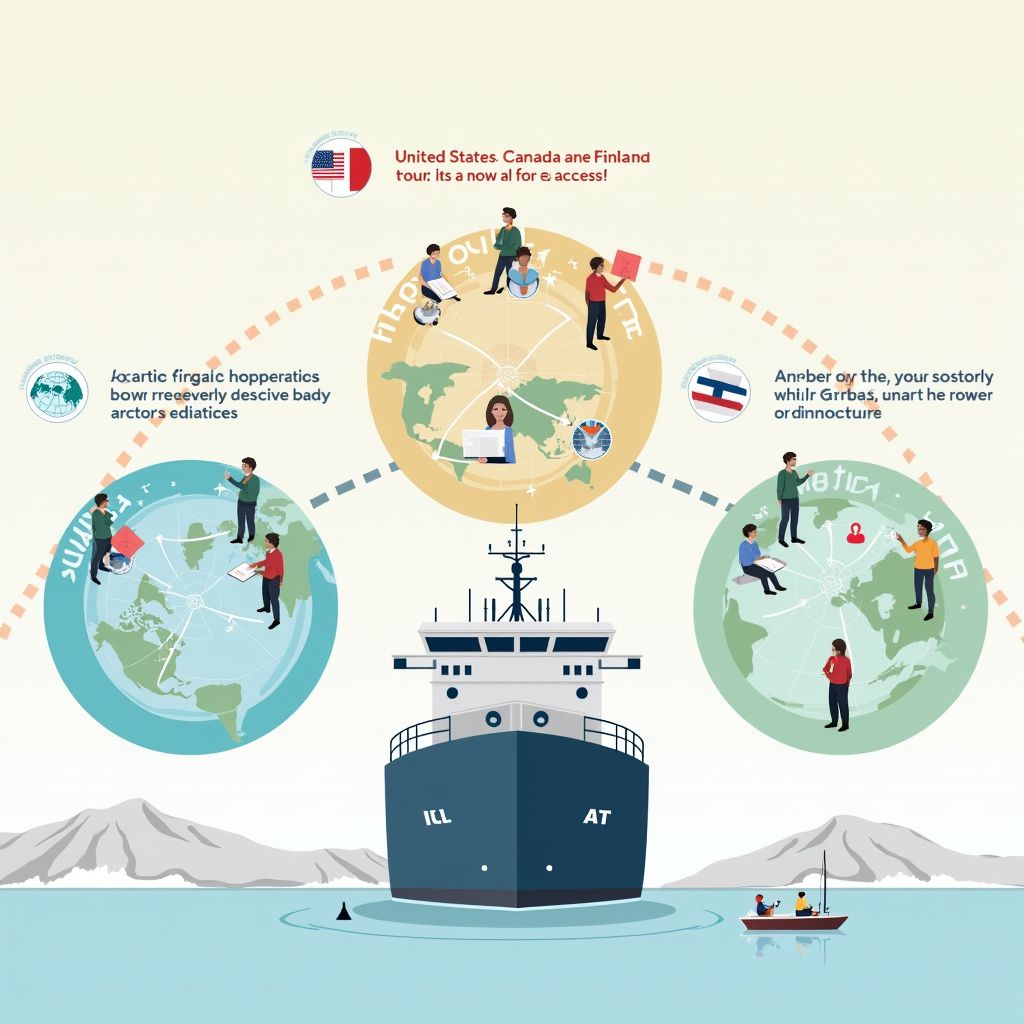
On 19 November 2025, the United States, Canada, and Finland announced a unique defence pact that places the Arctic region in a new strategic role. The so-called ICE Pact lays the foundation for the construction of eleven new icebreakers, four of which will be built in collaboration with Finland and Canada. The most striking development? Finland, a country not part of the Arctic Council, is taking on a formal security role in the region for the first time. This pact is not a traditional military alliance, but a technical and strategic collaboration aimed at securing access to northern waterways. It comes at a time when Russia and China are becoming increasingly active in the region, while the United States currently operates only two icebreakers. The cooperation also brings new job opportunities—through training American workers at Canadian and Finnish shipbuilding companies. It is a quiet yet powerful step in a world that increasingly views the Arctic as a zone of future security and economic value.
The Rise of the ICE Pact: A Strategic Move in the Arctic Region
On 18 November 2025, the United States, Canada, and Finland announced the Icebreaker Collaboration Effort (ICE Pact), a trilateral initiative aimed at strengthening security and technological capacity in the Arctic region [1]. The agreement, announced during a summit in Washington, D.C., and later confirmed in Ottawa, focuses on constructing eleven new icebreakers over the coming years [2][3]. The first four vessels will be built in collaboration with Finland and Canada, while the remaining seven will be constructed in the United States following a restructuring of national shipbuilding capacity [1][3]. This cooperation is seen as a direct response to growing strategic competition from Russia and China in the region, where melting ice caps are opening access to resources, shipping routes, and geopolitical influence [2][3]. The United States currently operates only two functional icebreakers, while a White House white paper indicates a need for nine additional ships to ensure the safety of northern seas [3]. The ICE Pact establishes a technical and strategic coordination mechanism that transforms the Arctic from a geographically remote area into a strategic frontline for national security [1][3].
Finland as a Key Player in a Non-Arctic-Oriented Alliance
One of the most remarkable aspects of the ICE Pact is Finland’s formal security role in the region—a country not part of the Arctic Council [1][3]. This role is unprecedented, as Finland has traditionally avoided formal military alliances with the United States and Canada in Arctic territory [1]. However, the collaboration is rooted in Finland’s global leadership in icebreaker technology: the country has a rich heritage of innovations since the 19th century, including specialized hull coatings, 360-degree rotating propulsion systems, and the ability to operate year-round in extreme climate conditions [3]. This expertise is essential for developing the new icebreakers, with the first four to be built in Finland under a memorandum of understanding signed in 2024 [2][3]. Finland’s contribution extends beyond technology: the nations have agreed to organise cross-border worker training programmes at shipyards, fostering the development of an American workforce in the icebreaker industry [2][3]. Finnish Minister of Economic Affairs Sakari Puisto emphasised that ‘navigating ice is not a technical problem, but a cultural heritage spanning more than a century’ [3].
Economic Impact and Labour Market Transformation
The ICE Pact has a clear economic dimension: it aims to create high-quality jobs for American workers through training at Canadian and Finnish shipyards [2][3]. The programme is linked to a $1 billion investment by the Canadian Davie shipyard in the Gulf Copper shipyard in Texas, where the American-built vessels will be constructed following training [3]. This investment is part of a strategic transformation aimed at revitalising the American shipbuilding capacity, which has been weakened since 2020 due to a shortage of vessels and declining workforce numbers [3]. The United States plans to build eleven new icebreakers, with the first four constructed in partnership with Canada and Finland, while the remaining seven will be built domestically after the restructuring of shipyards [2][3]. The initiative was supported by a federal law passed in July 2025, allocating nearly $9 billion towards the construction of Arctic security cutters [3]. The expectation is that this process will not only strengthen national security but also stimulate the economy through a sustainable, technology-driven job market [3].
Geopolitical Tensions and the Role of Media in the ICE Pact Narrative
The announcement of the ICE Pact took place on 18 November 2025, but was widely disseminated and highlighted in press releases and social media, including an Instagram post by Secretary Kristi Noem, who described the pact as a ‘historic trilateral agreement’ advancing American dominance in the Arctic [1][2]. In a tweet dated 18 November 2025, Noem wrote: ‘Under @POTUS Trump, we are finally asserting our Arctic dominance’ [1]. This approach illustrates how international agreements are increasingly announced through media attention, underscoring the role of journalism in shaping perceptions of geopolitical developments [1][2]. The formation of the pact coincides with a 17% increase in Arctic naval activity by Russia since 2024, according to the US Northern Command [1]. Additionally, 37 new military installations have been reported in the Kola Peninsula and Franz Josef Land since 2023 [1]. The United States has already planned three new Arctic surveillance stations for 2027, equipped with enhanced radar and communication systems in northern Alaska and Greenland [1]. Although the initiative is not a traditional military alliance, it is being portrayed as a ‘militarising trend’ that has prompted criticism from some experts warning of accelerated escalation in the Arctic [1][2].