AI Supports Students, but Teachers Remain Indispensable
amsterdam, dinsdag, 14 oktober 2025.
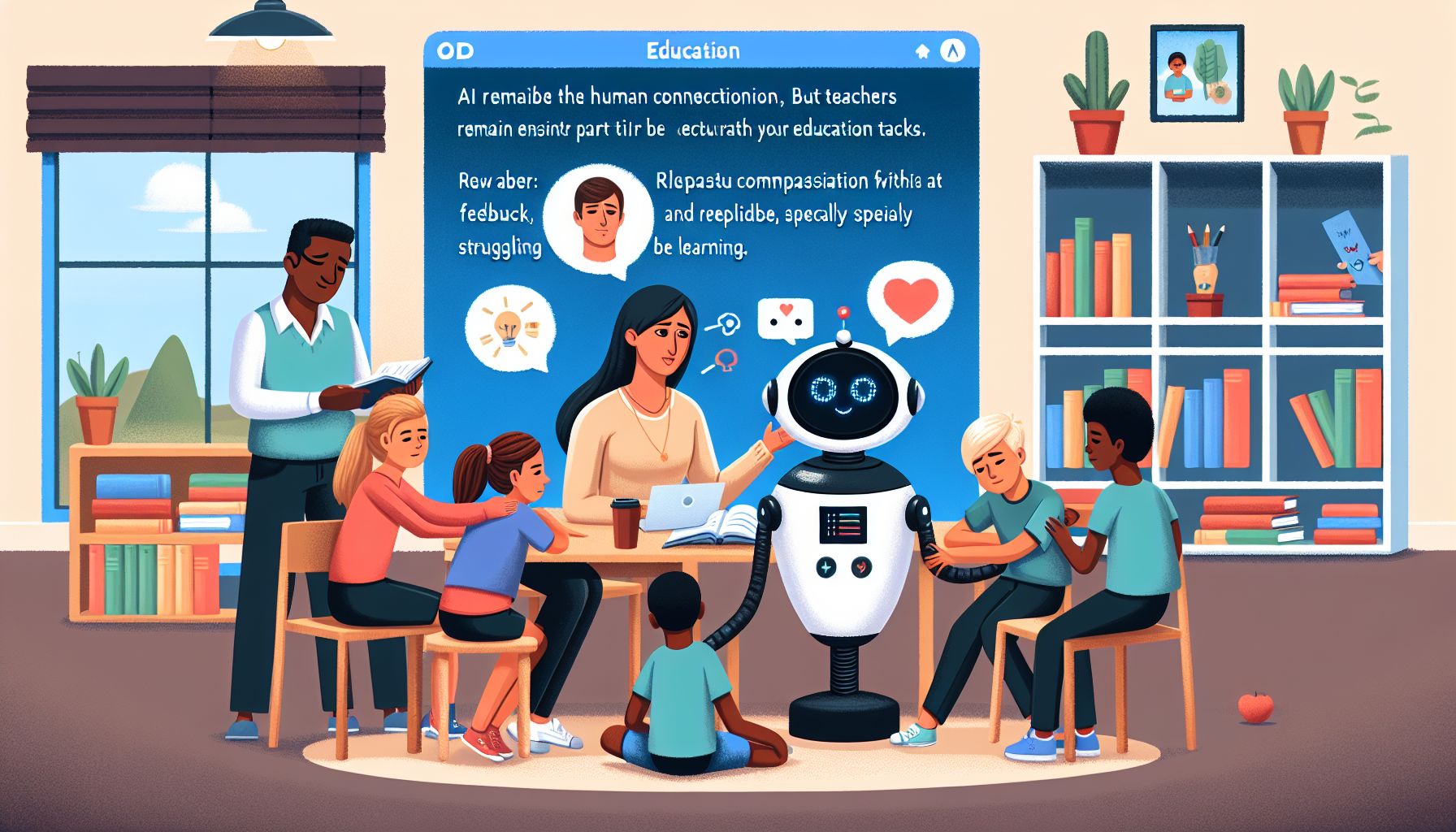
While AI bots can assist with feedback and exercises, teachers remain irreplaceable for guidance, comfort, and role modelling, especially for students with educational disadvantages. Despite the possibilities of AI, bots can never provide the human connection that is essential for education, particularly for vulnerable students.
AI as a Support Tool in Education
Artificial intelligence (AI) supports students through feedback and exercises, but it remains a supplementary tool. AI bots, for example, can help with grading assignments and providing immediate feedback, allowing students to make progress more quickly. This technology is particularly useful for students who need extra practice or who prefer to work at their own pace [1].
Teachers Remain Indispensable
Despite the benefits of AI, teachers remain irreplaceable. They not only provide knowledge about their subject area but also emotional support and serve as role models. For students with educational disadvantages, the human connection is crucial. Teachers can offer comfort, motivation, and a safe haven—things that an AI bot can never do [1][2].
Limitations of AI in Education
There are also limitations to the application of AI in education. While AI bots are efficient at giving feedback, they lack human intuition and empathy. For instance, they cannot tell a joke to lift a student’s spirits or engage in a deep conversation about personal issues. These human aspects are essential for a good learning process, especially for students who need emotional support [1][3].
Ethical and Practical Considerations
The integration of AI into education also brings ethical and practical considerations. There is concern, for example, about student privacy. How much data is collected, and how is it used? Additionally, there is the question of whether AI bots are always reliable in their assessments and suggestions. It is therefore essential that teachers retain control over the use of AI in the classroom [4][5].
Practical Examples of AI in Education
There are already several practical examples where AI has been successfully implemented in education. In the United States, for instance, a study has shown that language models like ChatGPT can provide excellent feedback on essays. In the Netherlands, institutions such as KlasCement organise workshops and courses to guide teachers in using AI tools. An example of this is the online course ‘CHATGPT AND CO: AI TOOLS FOR MATHEMATICS’ for mathematics teachers [3][5].
Conferences and Workshops
To support teachers in integrating AI into education, regular conferences and workshops are held. For example, last Wednesday, a lecture took place in the Kekulé cycle about the benefits of AI in the chemical industry, given by Prof. Dr. Steven Latré. These events provide a platform for sharing knowledge and experiences and help teachers to use AI responsibly and effectively [5].